
It’s one of the most common questions for people with vintage sewing machines: What’s this thing worth?
Some, like Singer’s Featherweight machines, can be valued at $1,000 or more. The Bernina 830 Record commonly sells for $500 or more.
The lowly Fashion Mate, not so much.
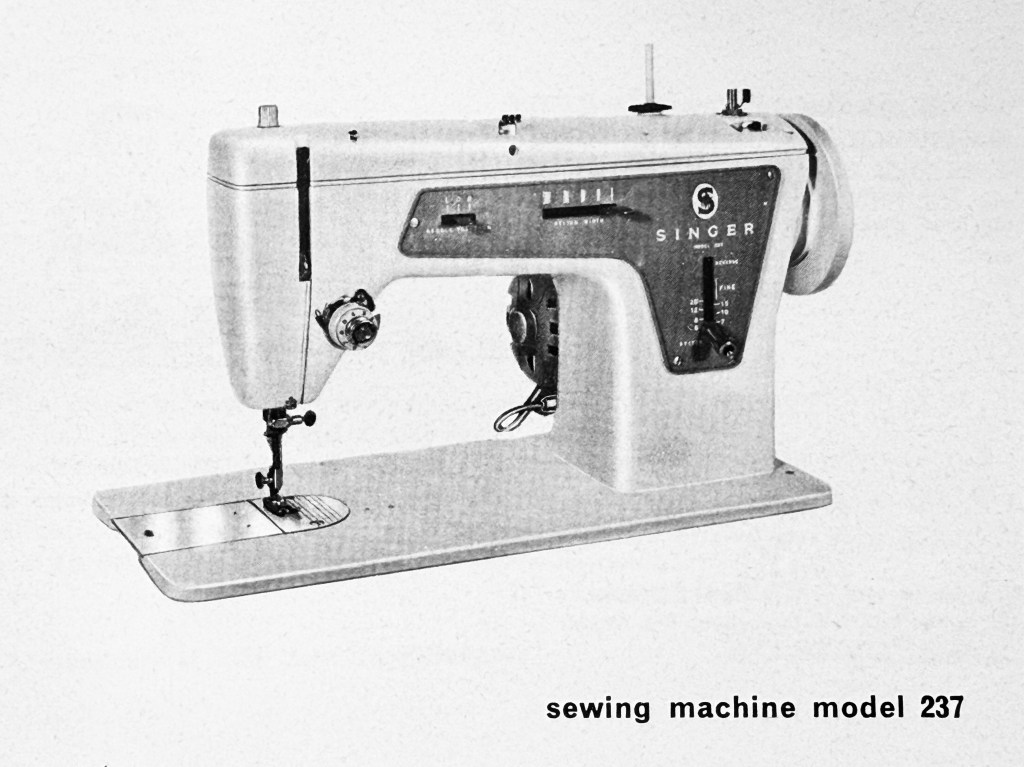
For one thing, Singer 237 machines are not rare, and date from the mid 1960s and early 1970s. They’re Gen X machines, not Greatest Generation machines. You won’t find them in The Encyclopedia of Early American & Antique Sewing Machines. They have some flaws. They came in cheap plastic cases that often do not survive. They do not have fancy features, like decorative stitches or buttonhole settings. They are “flat bed” machines that don’t convert to a “free arm” for sleeve and pant cuffs. Many were made in out-of-the-way plants, like Monza, Italy, rather than historic factories like South Carolina or Scotland. They were one of the last quality machines the company made before it spun off its century-long history of sewing machine manufacturing in 1986. It’s been called Singer’s “swan song,” and the artifacts from the decline of an empire are rarely prized.
Still, I have bought, rehabbed, sold and given away dozens of Singer 237 machines. Typically, I don’t look at anything more than $50. There are a number of reasons for this.
First, few people sew any more, and typically these machines are put up for sale after being found in a storage locker, basement closet or in a sewing desk that sat undisturbed in Grandma’s back bedroom for decades. There is no way to assess their condition on sight. (I bought one on Facebook Marketplace that looked pristine, only to find it literally stuffed full of rotting acorns and cotton pillow ticking stuffed into the machine by mice. Their urine had frozen the machine into rusty scrap metal.) Disuse is the biggest enemy of vintage sewing machines.
Second, that disuse is often the result of not just neglect, but some kind of breakdown. Everyone intends to bring their machine in for a “tune up” to get it running again, but no one ever does, usually because even a basic service charge is worth more than the machine, or more expensive than buying a cheap plastic junker online. Chances of buying a clunker 237 have grown by the day since they quit making these during the Nixon administration, and even the newest models are more than a half century old.
- How to value vintage sewing machines at ISMACS
- Are Old Sewing Machines Worth Anything? at North Shore Crafts
- Sewing Machine Blue Book: Used machines depreciation at Sewing is Cool
So, you are literally buying a pig in a poke every time you get a Fashion Mate, unless you’re buying from a rehabber, and you see video of the machine in operation. Anyone seriously interested in a Singer 237 knows this risk. Which is why you see them so regularly on Facebook Marketplace and EBay, posted for months, unsold, with a $100 price tag.
Offer $50 and see what happens. If the seller says no, just wait. Another machine will come along, or the seller will decide that $50 is easier than hauling it to Goodwill.
So, don’t expect to make a quick buck on a Singer 237. But if you are looking for sturdy, easy-to-use and easy-to-maintain basic sewing machine, I argue you cannot do better than the Singer 237.
Hang on to it! Use it to sew!


 Singer 237